The Object Reuse and Exchange initiative, under the Open Archives umbrella, aims to provide a method of describing complex digital objects in order to provide boundaries on an otherwise formless web. As scholarly communication becomes more open and personal, distinguishing and being able to cite online multi-resource objects becomes both more difficult and more important. In order to ensure that it is possible to reference existing works, and hence to provide an initial impetus for scholarly communication using these digital objects, a large scale collection of ORE-described academic resources is essential to provide citation targets and to facilitate further research. It is envisioned that these resources would then be cited from new works, and the descriptions used as surrogates for the work in institutional repositories with URI pointers to the originals held outside of the repository.
31 May 2010

29 May 2010
28 May 2010
wg/bibliography - Open Knowledge Foundation Wiki
wg/bibliography - Open Knowledge Foundation Wiki: "Working Group on Open Bibliographic Data
Purpose
Act as a central point of reference and support for people interested in open bibliographic data
Identify relevant projects and practices. Promote best practices as well as legal and technical standards for making data open (such as the Open Knowledge Definition).
Act as a hub for the development and maintenance of low cost, community driven projects related to open bibliographic data."
Purpose
Act as a central point of reference and support for people interested in open bibliographic data
Identify relevant projects and practices. Promote best practices as well as legal and technical standards for making data open (such as the Open Knowledge Definition).
Act as a hub for the development and maintenance of low cost, community driven projects related to open bibliographic data."
27 May 2010
22 May 2010
W3C Library Linked Data Incubator Group
W3C Library Linked Data Incubator Group: "The mission of the Library Linked Data incubator group is to help increase global interoperability of library data on the Web, by bringing together people involved in Semantic Web activities—focusing on Linked Data—in the library community and beyond, building on existing initiatives, and identifying collaboration tracks for the future."
18 May 2010
17 May 2010
14 May 2010
11 May 2010
09 May 2010
Open Government Data in Austria
Open Government Data in Austria: "
The following guest post is from Andreas Langegger who is at the Johannes Kepler University Linz and member of the Open Knowledge Foundation’s Working Group on EU Open Data.
Historically, transparency has never been our strength – let’s shape the future.
Transparency and public sector information policy have always been rather infamous topics in Austria. While the USA, UK, Finland, and other Scandinavian countries are opening more and more public data sets in order to promote citizens’ participation and enable new businesses, — in Austria there have been heated debates around opening up databases from public bodies (e.g. for farm subsidies). The European PSI directive from 2003 was implemented into national law as the IWG or Informationsweiterverwendungsgesetz, but instead of opening data sets to the public there have been a number of public bodies which have violated against the (actually very weak!) law by not responding to inquiries. A company which is providing high quality business data was even sued by the republic for collecting and using data from public databases (OGH decrees 4Ob11/07g, 4Ob35/09i, etc.). Many public bodies are sitting on huge data silos. Many don’t even have a plan what’s inside in these silos, some of them collect equal data twice, and most of them are afraid of sharing anything. If there are no laws promoting the reuse of open government data sets, risks will be too high for companies to use and benefit from government data.
Open government data initiatives around the world are a big chance to make a change and present success stories and incentives to the public and policy makers. Of course, it will be a question of which data sets to open and what the consequences are. In a workshop with Rufus Pollock we could see that there are big differences between Austrian and Anglo-American and Scandinavian mentality: before we do something, we think out all possible (bad) consequences. Which is good, but firstly, this might take a while, secondly, we might think of more problems than there will actually turn out, and thirdly, sometimes the overall social benefit will just exceed costs. The evaluation of this total social benefit is of course very difficult, and even more difficult to explain to people. By drawing analogies to other public domain goods such as software and digital music, Rufus Pollock has shown how this benefit can be estimated. Digital information are resources, which can be copied without any marginal costs. They have to be collected anyway, but the more we make use of them, the better. Another point is the immense creative potential residing in the masses. Crowd sourcing might help politicians to get new ideas from their voters. There are many experts who would never get into politics, but could contribute interesting solutions to ongoing problems. And finally, there are many so-called “professional amateurs” who would provide time and effort to solve issues, combine, fix, analyse, and visualize key data sets or hack out useful applications based on open government data.
The Austrian Agenda
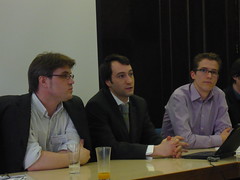
After the first informal meeting of Semantic Web researchers and a few economists in January, we organized a kick-off event on April 8th, whose goal was to bring people together who are interested and committed to start an Austrian Open Data Initiative. We were very happy to get support from Rufus Pollock, who moderated an afternoon workshop, participated in a press conference panel, and held a keynote at the main event. About 55 people have attended the meetup and their feedback was very good and motivating. After the lightning talks in the end, the event lasted from 2pm to 10pm. We’ve also had a great echo in the press. All the results and slides can be viewed on the website of the Zukunftsweb (“future web”) project.
Since the meetup we were having lots of discussions with different kinds of people. Last week I met with a parliamentarian from the Austrian people’s party and we discussed about the Austrian situation and what we can do in order to promote the initiative at a political level. We also discussed about kinds of datasets and business cases which are very important to demonstrate what will be possible. I am very excited how our initiative will evolve. Besides having promising use cases and success stories from other countries, one thing seams clear to me: without political support and commitment, it will be a bumpy road to success. Hence, lobbying and opinion making will be one of our major goals in the near future.
Our next meeting will be on May 12th. There, we will create an Austrian OKFN Chapter and a national association. Since we are currently still in the forming phase, we don’t have any ‘apps’ to show. Applications and websites for traffic information, public transport schedules, bicycle routes, parliamental decisions, etc. are currently provided and maintained by public bodies. As a matter of fact, there is no competition and thus, usability, accessibility, and range of features could be much better in future. I am looking forward to new applications based on open government data and I am sure we will once have an Apps For Democracy contest running in Austria too.
Related posts:
"
Subscribe to:
Posts (Atom)